Ukraine has incurred hundreds of billions of US dollars in damage and losses caused by the war. The cost of reconstruction is enormous. The Third Rapid Damage and Needs Assessment sheds the light on the scale of work needed to reconstruct the country. This article focuses on infrastructure as a vital network for the country’s recovery.
Estimation of damage, losses, and needs
Recently, the Government of Ukraine, the World Bank, the European Union, and the United Nations jointly performed the Third Rapid Damage and Needs Assessment (RDNA3). The assessment, which covers the period from February 2022 to December 2023, comprehensively analyses the impact of the war on social fabric, infrastructure, productive sectors, and human well-being.
The overall damage is estimated at US$152 billion. This is the direct damage to physical assets from the beginning of the war Russia started against Ukraine in February 2022. The losses, which include indirect damage and associated costs caused by the war, are more than twice as high – US$499 billion. The sectors most profoundly affected include housing, transportation, commerce and industry, agriculture, and energy. To rebuild the damaged assets with a commitment to building back better principles and to facilitate Ukraine’s recovery, an estimated US$486 billion will be needed over ten years.
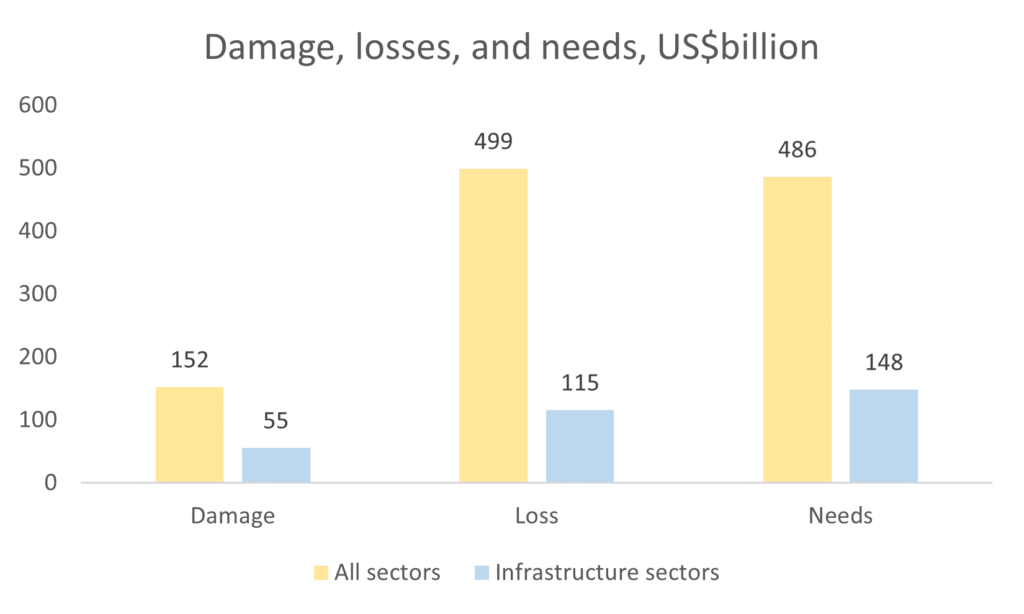
The infrastructure sectors (energy, transport, telecommunications, water and sanitation, and municipal services) account for a significant part of the damage and losses, constituting 36% of total damage, 23% of losses, and 30% of reconstruction and recovery needs. Notably, the infrastructure in the eastern and southern regions suffered the most significant impact of the war due to its proximity to the frontline.
As demonstrated by RDNA 3, the energy and transport sectors bear the most considerable burden of damage, losses, and needs. Russia’s strategic focus on targeting energy infrastructure aims to disrupt civilian life and industry, leaving communities and businesses struggling to function as usual. Meanwhile, transport infrastructure grapples with damage caused by military activities and significant losses from disrupted logistics chains.
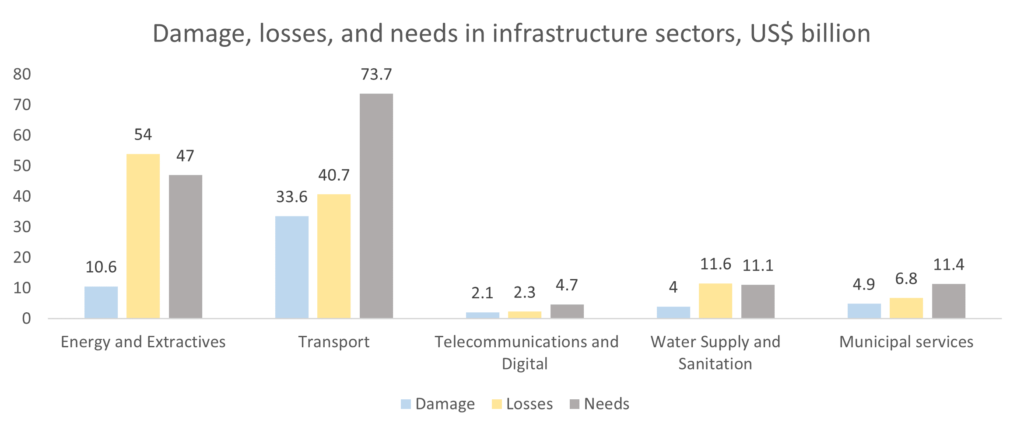
Infrastructure is a driver and catalyst of economic, social, and industrial activities, and its restoration is vital for the country’s recovery. However, reconstruction will be challenging, as considerable financial resources are necessary to recover the infrastructure. As of the end of 2023, the need was estimated at US$148 billion. Furthermore, the complete reconstruction is a lengthy process; according to the RDNA3 report, achieving the identified goals will take more than ten years. Examining key infrastructure sectors suggests insight into the scope of damage and strategies Ukraine will potentially employ to respond to the associated challenges.
Energy sector
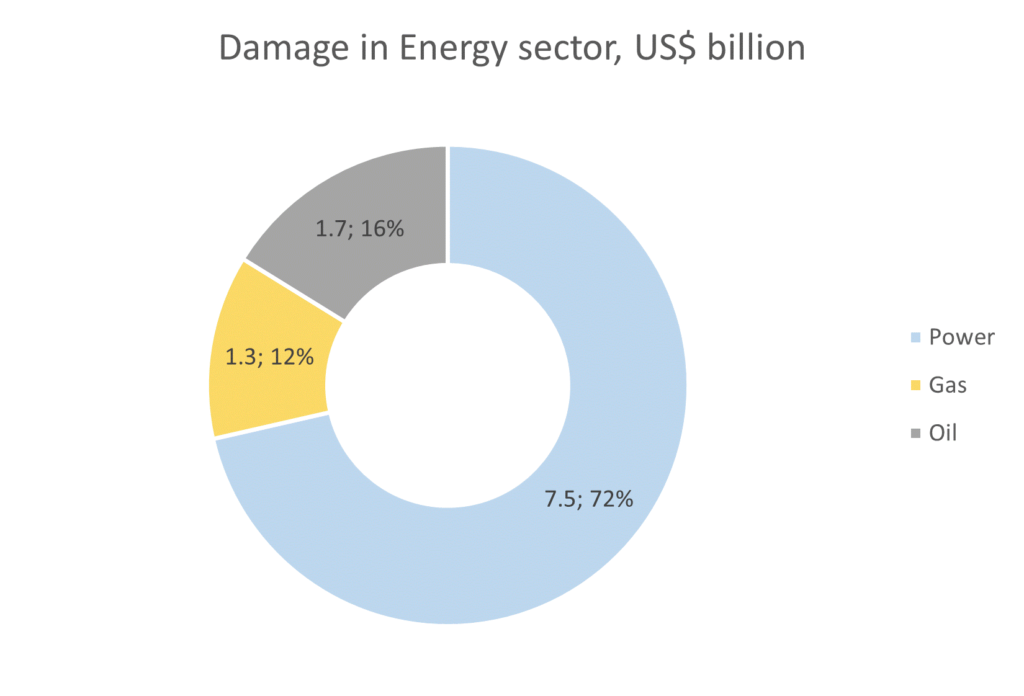
Total damage to the energy sector is estimated at US$10.6 billion with the power infrastructure being the most affected; it accounts for more than 70% or US$7.5 billion. The sub-sectors of oil and gas account for 16% and 12%, respectively. The majority of damage occurred in 2022 – 2023 when Russia launched a massive attack on energy infrastructure in an attempt to leave Ukrainians without electricity and heating in winter. In 2023, the major accident that contributed to the accumulation of damage was the destruction of the Kakhovka hydropower plant.
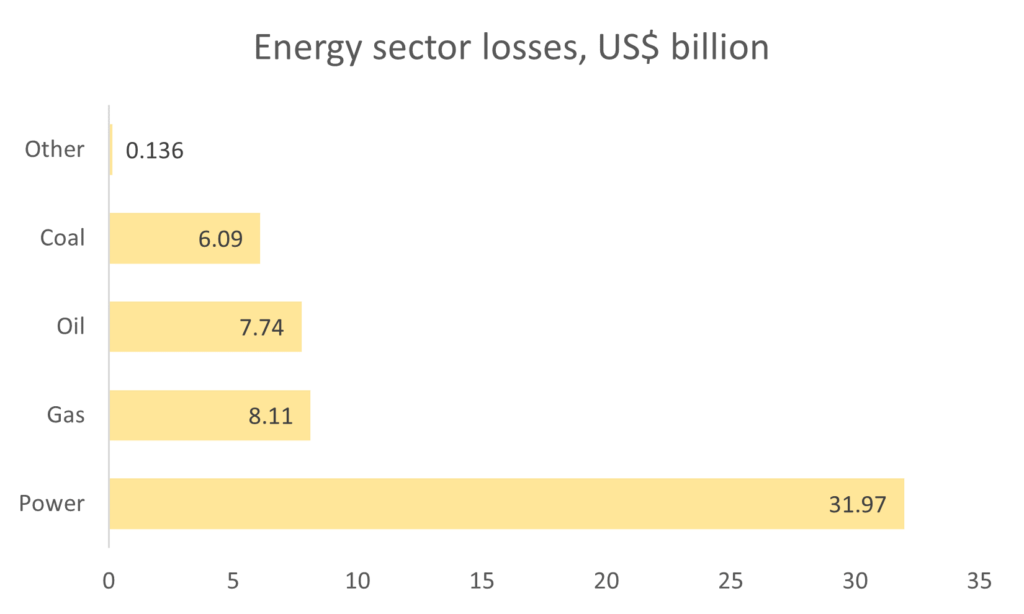
Losses in the energy sector reached US$54 billion, with the power sector being the most affected (59%). The losses mostly represent revenue loss by energy sector operators. This is a consequence of direct damage to the infrastructure and shifts in the country’s demographic landscape, displacement of people, and increased poverty, leading to decreased collection rates.
Ukraine must invest US$47 billion over the next decade to reconstruct and recover the energy sector. Most of these funds are necessary for rebuilding power generation infrastructure with building back better principles. In the short term, it is crucial to reconstruct damaged infrastructure and restore services to ensure proper conditions for the life of society and business and not inhibit the economic and social development of the country in the harsh conditions of war. In the reconstruction process, compliance with international climate obligations and requirements for joining the EU in terms of decarbonization of the economy is essential; it should lay the foundation for the principles of long-term recovery. In the long term, the energy sector’s infrastructure must be rebuilt and modernized so that Ukraine has an energy-efficient, sustainable, green, reliable, and secure energy system.
Transport sector
The total damage to the transport sector is estimated at US$33.6 billion. The most impacted type of infrastructure is roads of local importance (26%), followed by railways infrastructure (24%) and national roads (23%). Most of the damage occurred in 2022 when there were significant advances at the frontline and liberation of territories.
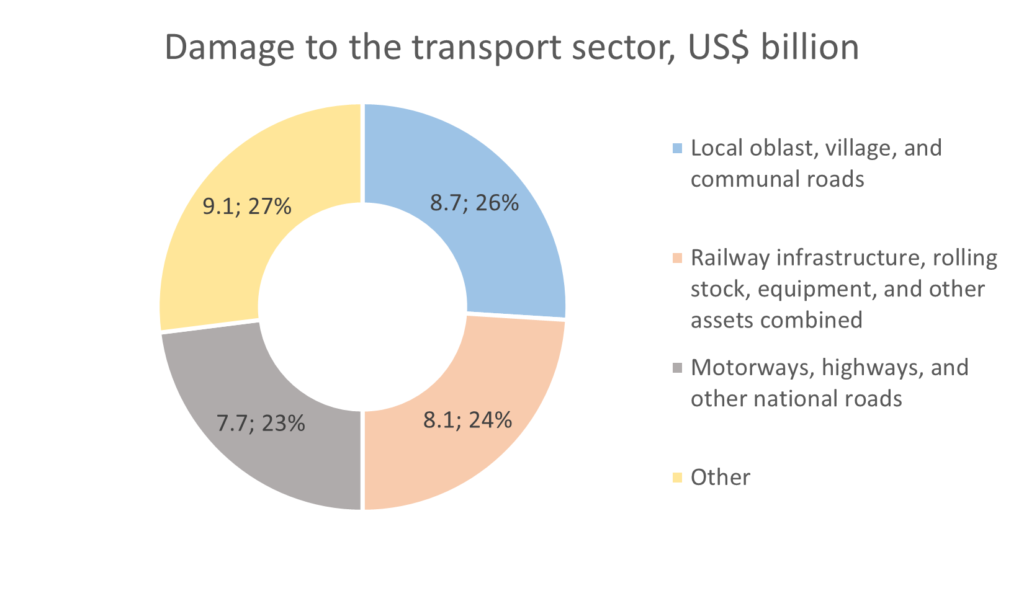
In 2023, there was no dramatic change in damage due to a comparatively steady frontline. However, during this period, Russia decided to target more export infrastructure, such as seaports, aiming to undermine Ukraine’s position as a grain exporter.
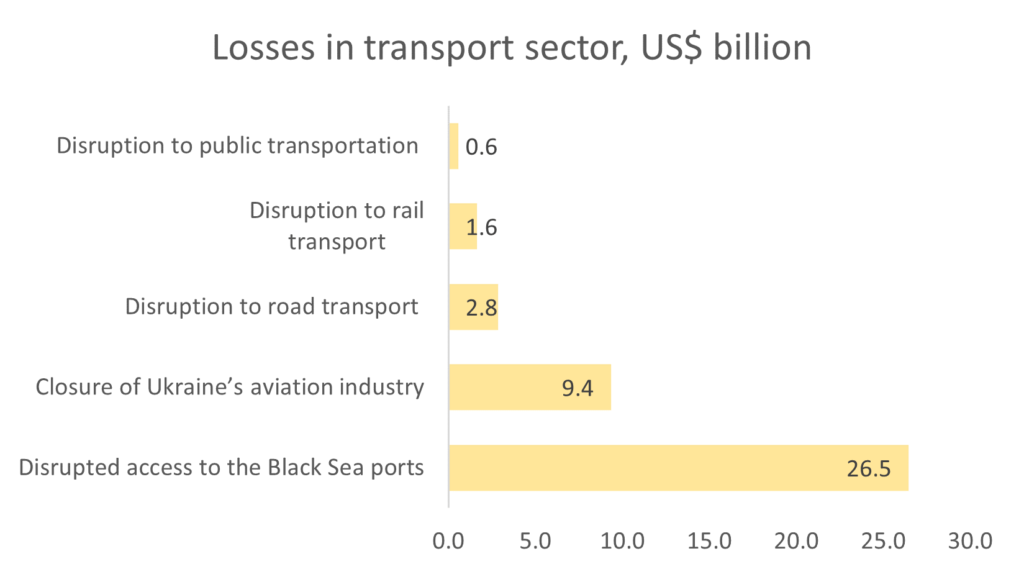
Losses in the transport sector are hefty—US$40.7 billion—primarily due to disrupted access to the Black Sea ports (65%) and the closure of the aviation industry (23%). Despite the enormous losses in the transportation industry, several initiatives helped to facilitate transportation and the export industry: the Black Sea Grain Initiative (BSGI) and the EU’s Solidarity Lanes. BSGI alone boosted exports that reached 45 million tonnes per year.
The transport sector requires US$73.7 billion over the next ten years. The main principles of rebuilding better transport infrastructure will be decarbonization, efficiency, and multimodality. The reconstruction priorities center around strengthening Ukraine’s export capacities, enhancing lifeline connectivity, and restoring disrupted services. In 2024, it is planned to continue repairing roads, railways, bridges, and ports and restoring the postal services infrastructure.
Municipal services sector
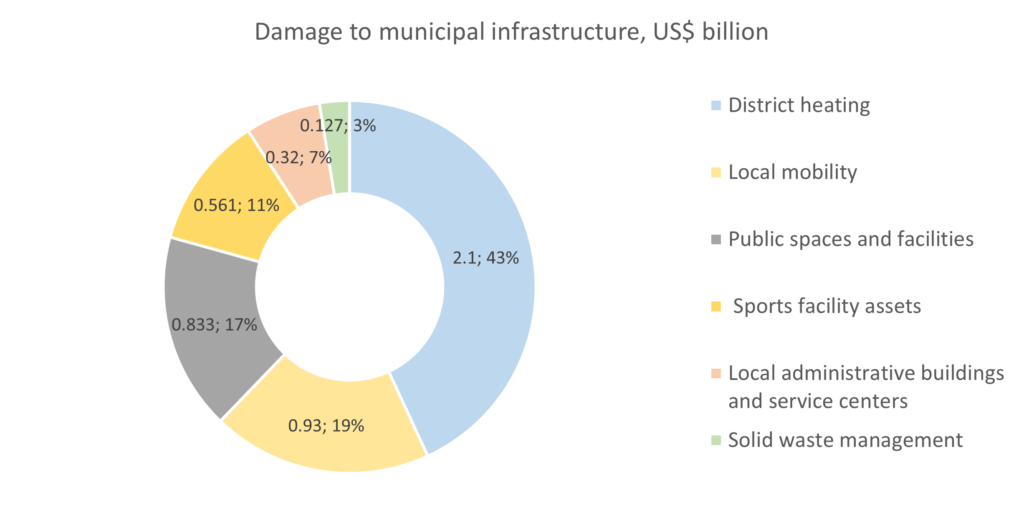
The damage to municipal services infrastructure is estimated at US$4.9 billion. This amount includes damage to public infrastructure and facilities, local administrative buildings, sports facilities, local mobility assets, solid waste management, and district heating infrastructure. The largest share of damage accounts for district heating (42%), followed by local mobility assets (19%) and public spaces and facilities (17%). More than two-thirds of total damage is concentrated on territories close to the frontline.
Losses in the municipal infrastructure sector are US$6.8 billion. The most significant part of the losses comes from the district heating sector (35%). Estimated losses also encompass the loss of local government revenues in the form of taxes and fees and the cost of debris removal.
US$11.4 billion is needed to reconstruct the damaged infrastructure over the following ten years. In the short term, debris removal and recovering disrupted municipal services are the main tasks. In the long term, local governments should apply Green Deal principles during asset reconstruction with a strategic approach to making no-regret investments. Specific emphasis is placed on solid waste management and district heating as sectors that needed substantial modernization and improvement even at the pre-war stage.
Water supply and sanitation
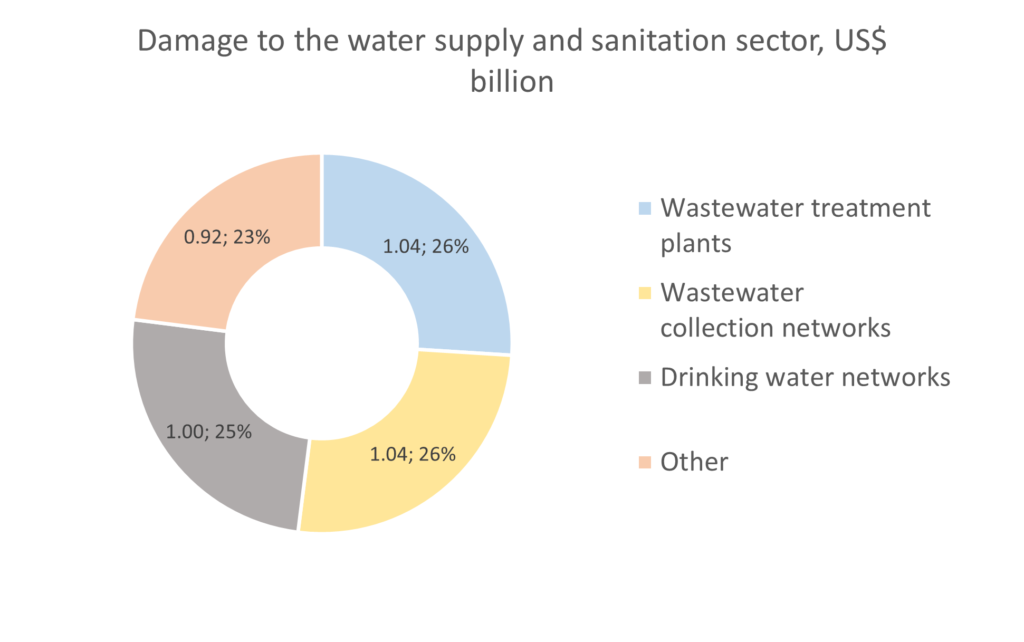
US$4 billion is estimated to be damage to the Water supply and sanitation (WSS) infrastructure caused by the war. The largest part of the damage is associated with the wastewater treatment facilities and drinking water networks.
Losses in the WSS sector are estimated at US$11.6 billion. Most losses are caused by WSS service providers’ loss of revenues.
The loss of revenues happened for several reasons: first, decreased number of consumers, both industrial and individuals; second, the collection rate in the war conditions became low. Moreover, the providers of WSS services suffer from increased costs for such resources as energy and fuel. The situation is even more aggravated due to the freezing the tariffs for WSS services during the war, depriving the providers of additional funds to operate and maintain the infrastructure.
It is estimated that US$11.1 billion will be needed to reconstruct and recover the WSS sector during the following ten years. In the short term, repairing damaged infrastructure, strengthening local capacities, and elaborating recovery plans are prioritized. In the long term, green reconstruction and the planning of WSS infrastructure are envisaged to align with the requirements of the EU accession criteria.
Telecommunications and Digital sector
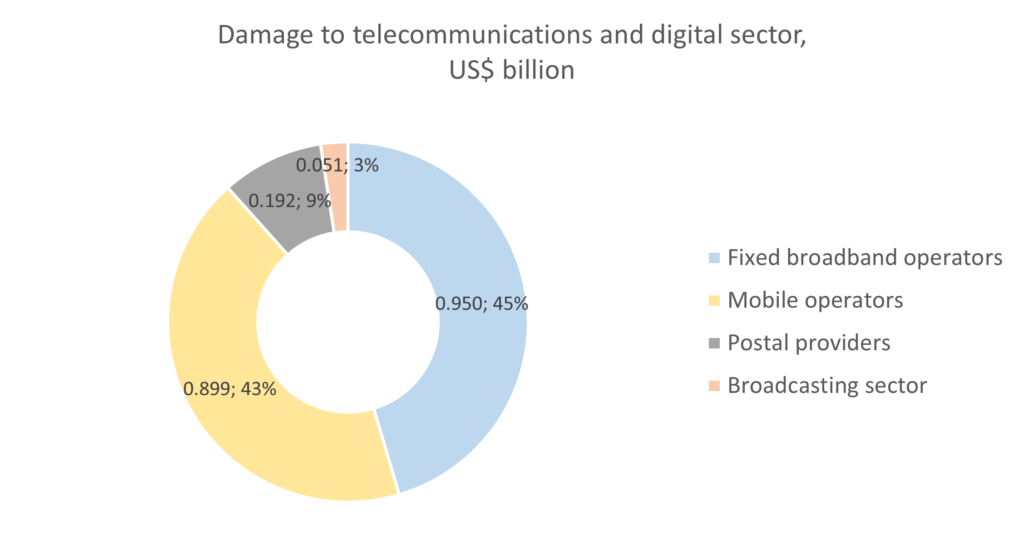
The total damage to the sector is estimated at US$2.1 billion. The fixed broadband and mobile operators were the most affected, with 45% and 43% of the damage, respectively. Postal providers and the broadcasting sector suffered much less, with 9% and 3% of damage, respectively. Except for the eastern and southern regions of the country, the Kyiv area was also one of the most affected.
Losses in the sector are US$ 2.3 billion; this figure represents the losses due to the disruption of the services caused by the war and additional energy costs that the operators incurred due to attacks on energy infrastructure and the need for backup energy provision. The largest share of losses accounts for postal services providers (65%) and mobile operators (30%). Unlike other sectors, where losses are concentrated at the frontline territories, the largest share of losses incurred in the telecommunication and digital industry in Kyiv oblast.
The telecommunications and digital sector requires US$ 4.7 billion for recovery and reconstruction. 43% of the needs are associated with rebuilding damaged assets, while the rest are about restoring service delivery, including strengthening cybersecurity. Cybersecurity is one of the highest priorities in the sector, as russians make attempts to attack the digital infrastructure and disrupt the services, causing panic among the Ukrainian population, as it happened with one of the largest mobile operators (serving 50% of the population), the service of which disappeared for several days due to significant cyberattack.
Reconstruction Challenges and opportunities
The assessment of damage, losses, and needs shows that Ukraine has an enormous amount of work to do to reconstruct infrastructure, and this does not take into account that the war is not over yet. During and after the war, the Government of Ukraine has a serious challenge keeping up with regular maintenance of the infrastructure and rebuilding the damaged one with building back better principles. The building back better principle implies sustainability and resilience, modernization and innovation, climate change mitigation, and community-driven choices. In essence, the objective is not solely about replicating the destroyed object; it is also about evaluating the necessity for its restoration and defining parameters that align with current needs.
Considering the vast damage and the need to rebuild the destroyed infrastructure, it is evident that Ukraine will face financial and operational challenges in the short- and medium-term. The financial gap is inevitable, and the Ukrainian government will seek various types of financing: international development banks, donors, private investors, blended financing, etc. From an operational point of view, it won’t be easy to implement all those projects with the capacities of state and municipal companies. Ukraine will have to rely heavily on private sector actors, including foreign companies. Moreover, human capital is equally crucial – all these companies will need people to perform work. Will the country have a sufficient internal pool of talent? So far, such assessments have not been conducted, but there are risks that the country will have a shortage of human resources.
An essential prerequisite for all those planned interventions is thorough strategic planning and prioritization. There is a chance of failing successful and effective reconstruction at such a large scale if there is a lack of vision, strategy, and transparency enabling controls at various levels and preventing chaotic actions and corruption. Implementation of such initiatives as the RDNA and other sectoral assessments that are carried out by the Government of Ukraine and international organizations today; the launch of the DREAM platform, which consolidates information on reconstruction projects, are the first steps towards strategic planning and transparency of the country’s reconstruction process.
Implementing the EU Directives targeting climate change mitigation and building a green economy will require managing reconstruction according to the new rules. On the one hand, this imposes new obligations on the country already under strain, but on the other hand, it is an opportunity to build a better future and become one step closer to advanced countries. Implementing EU legislation for “green” reconstruction and applying new construction standards in practice will require capacity building of public institutions and businesses. Thus, capacity building for national and local governments and private sector actors will be necessary to fulfill Ukraine’s decarbonization objectives within the EU accession commitments.
Despite many challenges confronting Ukraine today, one should always remember that challenges bring new opportunities. This is a chance for Ukraine to rebuild a country with innovative, efficient, demand-driven, and green infrastructure. It is an opportunity for international businesses to bring their know-how to Ukraine and create healthy competition for local businesses. It is a chance for the Ukrainian Government to set the foundation for sustainable development for decades ahead by taking strategic and visionary actions.
Well written, insightful article. Thank you