The global system that finances large-scale investment projects is being reorganised around different actors, different instruments, and different terms than those that prevailed for the past three decades. COVID-19 accelerated some of these shifts; the return of geopolitical competition, the contraction of US engagement in multilateral institutions, and the rise of Gulf sovereign capital as a global force have deepened them further. This note draws on the OECD’s Multilateral Development Finance 2026 report, recent World Bank and IFC data, and analysis from the Center for Global Development and ONE Data to map where the system stands today and what the changes mean in practice for governments and project developers.
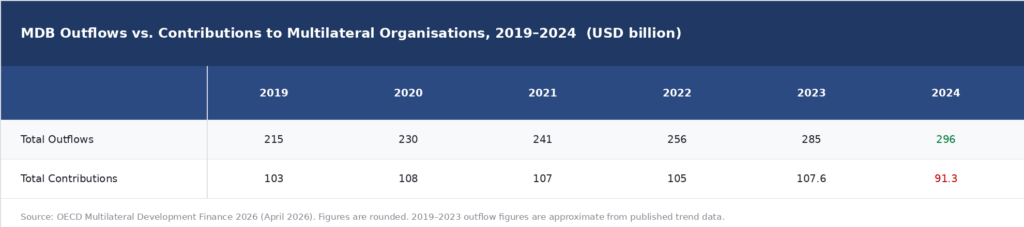
Multilateral outflows have reached record levels, but the financing base that sustains them is contracting. Total multilateral outflows reached $296 billion in 2024, up 37% from pre-pandemic levels and 4% above 2023, according to OECD data published in April 2026. Multilateral development banks now account for 56% of all net development finance flows to low- and middle-income countries, compared with 28% a decade ago, with MDB financing to these economies having grown by 124% since 2010. Yet the same OECD report warns that current outflow levels “reflect delayed adjustment rather than underlying stability.” Total contributions to multilateral development organisations fell to $91.3 billion in 2024, a 15% decline from the 2023 all-time high of $107.6 billion, with further reductions projected through 2027. The system is drawing on leveraged balance sheets and replenishment cycles to maintain delivery, a position that can be sustained in the short term, but not indefinitely.
The contraction of US engagement has been the single largest structural shock to the system since the 1940s. The United States was, until recently, the largest provider of official development assistance globally, contributing approximately 30% of total ODA, around $65 billion in 2024. US ODA fell by 56.9% in 2025, the sharpest contraction recorded by any DAC (Development Assistance Committee) member country in the modern era. Germany became the world’s largest bilateral donor for the first time. The OECD projects a further 5.8% decline in total DAC ODA in 2026, following a 23.1% contraction in real terms in 2025, when DAC ODA fell to $174.3 billion. Beyond aid volumes, the US has historically underpinned the AAA credit ratings of MDBs through its role as anchor shareholder, the foundation on which these institutions borrow cheaply from capital markets and on-lend at concessional rates. Both Moody’s and S&P have flagged that a material reduction in US commitment poses credit risks to the World Bank and peer institutions. Those ratings have been maintained, but the conditions supporting them are less settled than at any point since these institutions were created. The closure of USAID has compounded the problem: it removed not only grant financing but a substantial body of technical assistance and project preparation support that helped identify, structure, and de-risk projects to the point where MDB and private capital could engage. That pipeline function has no direct successor at equivalent scale.
Gulf sovereign wealth funds have emerged as the most consequential new actors in global infrastructure finance. The five principal GCC funds, namely Saudi Arabia’s Public Investment Fund, Abu Dhabi Investment Authority, Mubadala, ADQ, and the Qatar Investment Authority, collectively deploy long-horizon capital across infrastructure, renewable energy, logistics, critical minerals, digital assets, and advanced manufacturing, with a growing focus on emerging markets in Asia, Africa, and the broader Middle East. According to analysis published by the Stiftung Wissenschaft und Politik in February 2026, these funds now participate in nearly 20% of large infrastructure deals worldwide and are expanding their presence beyond London and New York into China and other key Asian financial centres. Unlike traditional MDB financing, Gulf sovereign capital carries no governance conditionality or the environmental and social standards frameworks developed by the Bretton Woods institutions. It does carry a clear strategic rationale: economic diversification, supply chain positioning, and geopolitical influence. Project developers and governments seeking this capital need to understand that rationale and how it shapes both where funds are deployed and on what terms.
The EU’s Global Gateway and a restructured World Bank are the two most significant institutional responses to the shifting finance environment. The Global Gateway Fund, operationalised through the European Investment Bank, channels equity, quasi-equity, and structured debt into clean energy, transport, digital connectivity, and human capital projects in emerging markets, governed explicitly by EU environmental standards and procurement frameworks. It represents the primary standards-based alternative for project developers who have lost access to US-backed financing. The World Bank, meanwhile, is in the midst of its most significant internal restructuring in a generation: IBRD, IDA, and IFC knowledge functions have been merged into five integrated verticals, people, prosperity, planet, infrastructure, and digital, with the stated goal of shifting from measuring disbursement volumes to measuring development impact and, critically, mobilising substantially more private capital alongside public resources. IFC’s recently concluded $6 billion credit insurance facility with a consortium of 19 global insurers, designed to support up to $10 billion in new lending, is the largest private capital mobilisation under a single MDB agreement to date and illustrates the direction of travel.
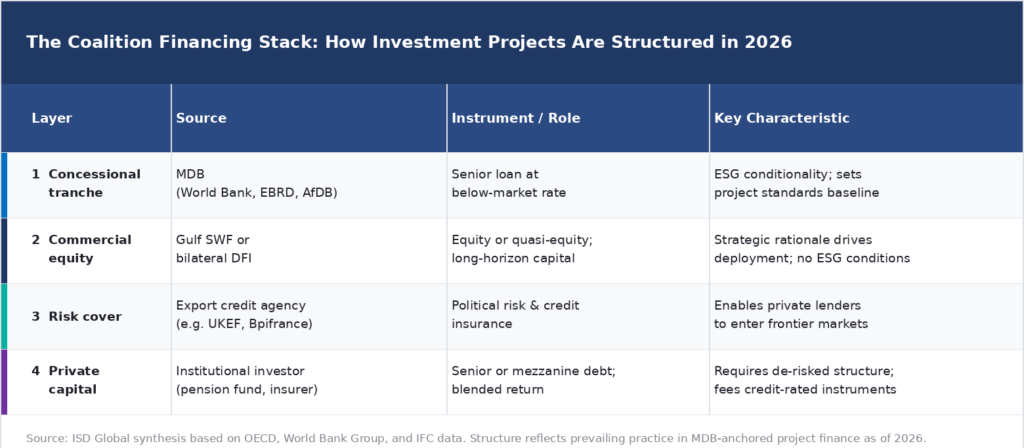
For project developers and governments, these changes translate into four concrete shifts in how investment projects need to be prepared and structured. First, project preparation has become a competitive differentiator: with USAID gone and MDB grant windows tightening, projects that reach financiers with rigorous feasibility analysis, credible financial models, and well-structured cost-benefit assessments have a measurable advantage in accessing the remaining pools of concessional capital. Second, coalition financing structures are now the norm rather than the exception: a concessional MDB tranche, commercial equity from a sovereign wealth fund or bilateral DFI, export credit agency cover, and private institutional capital each require distinct risk allocation and return profiles, and projects need to be designed from the outset to accommodate this layering. Third, the choice of financing source now implies a choice of regulatory and reporting environment: MDB financing carries established ESG standards; Gulf and some bilateral alternatives do not, which affects compliance obligations, reputational exposure, and access to future financing. Fourth, across the World Bank, EBRD, AfDB, and peer institutions, catalysing private investment has become the primary institutional performance metric: projects structured around blended finance instruments such as guarantees, first-loss tranches, and currency hedging facilities are aligned with MDB incentives in a way that conventional sovereign loan requests are not.
The pace at which these reforms translate into genuinely different project outcomes remains to be seen. New instruments exist; new actors have entered the field; new financing coalitions are being assembled. Whether these developments produce a more effective and coordinated system, or a more fragmented one, will depend in large part on decisions that governments, project developers, and financiers are making now.
ISD Gonsulting provides investment advisory, project preparation, and economic analysis services to businesses, governments, and development organisations. This article draws on data and analysis from the OECD, the World Bank Group, ONE Data, the Center for Global Development, Devex, and the Stiftung Wissenschaft und Politik.