When reconstruction needs run into the hundreds of billions, the hardest challenge is deciding what to finance first, and being able to justify that decision to the institutions providing the funds. Ukraine first introduced medium-term public investment planning in 2025 as one of the practical steps in its public investment management reform. The new Medium-Term Plan of Priority Public Investments for 2027–2029, approved in June 2026, continues this reform cycle and is designed to guide the selection of public investment projects for inclusion in the Unified Project Portfolio and access to state budget financing or state support.
The scale of the problem
Ukraine’s reconstruction challenge is one of the largest faced by any country in modern history. According to the Fifth Rapid Damage and Needs Assessment (RDNA5), cited directly in the plan, total recovery and reconstruction needs stand at $587.7 billion, more than 12% above the previous estimate.
That scale creates a specific and well-documented problem: without a structured approach, financing flows to projects that are visible and politically urgent rather than to those that are well-prepared and capable of delivering lasting value. Fragmented decision-making, overlapping project lists and inadequately documented proposals have been consistent concerns raised by donors and international financial institutions throughout the recovery process.
The Medium-Term Plan is a direct institutional response to that problem.
What the plan contains
The plan covers the 2027-2029 period with a total investment envelope of UAH 270.9 billion, frontloaded toward 2027. The annual breakdown is UAH 123.7 billion in 2027, UAH 82.3 billion in 2028, and UAH 64.9 billion in 2029. It spans 18 priority sectors, 44 subsectors and 67 main investment directions.
The financing structure is as significant as the headline figure. Of the UAH 270.9 billion total, UAH 150.8 billion is expected from the state budget general fund, and UAH 114.1 billion from international financial organisations and foreign governments, of which UAH 14.6 billion is grants and technical assistance. State guarantees account for a further UAH 4.9 billion. In other words, approximately 42% of the plan’s financing depends on international partners, which gives the quality and credibility of the planning framework direct commercial relevance.
The three largest sector allocations, based on the plan’s own figures are education and science, transport and postal services, and municipal infrastructure and services.
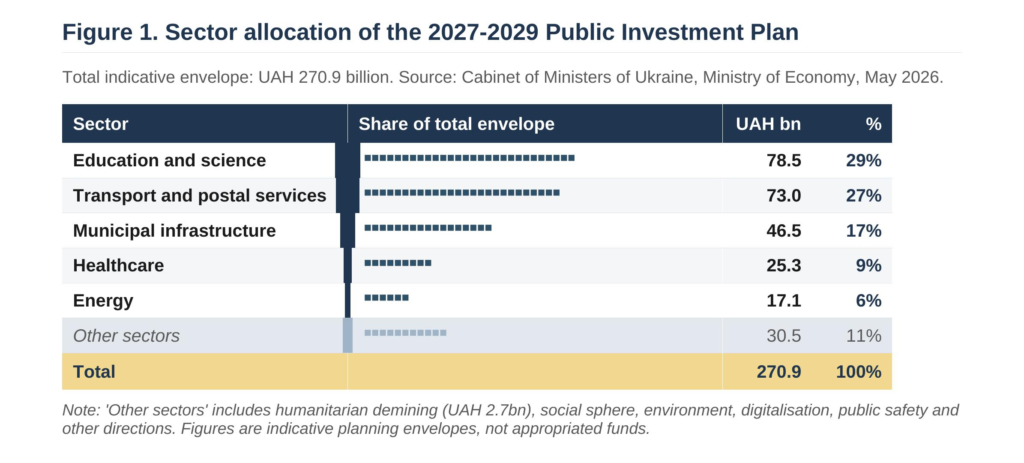
The plan also names five cross-cutting strategic goals that must be applied across all investment directions: energy efficiency, digitalisation, climate response, gender equality and barrier-free access. These are not supplementary criteria. They reflect the standards that EU institutions and international donors now apply when assessing project eligibility.
One sector worth highlighting is humanitarian demining, listed as a standalone investment sector with UAH 2.7 billion allocated. Its inclusion reflects the direct link between land clearance and economic recovery: agricultural production, construction, transport and industrial redevelopment all depend on it.
The 2027–2029 Plan builds on Ukraine’s first Medium-Term Plan of Priority Public Investments for 2026–2028, approved in 2025. The basic logic remains the same: medium-term planning, defined priority sectors, main investment directions and portfolio-based project selection. At the same time, the new cycle reflects a more developed framework. Compared with the first plan, the number of priority sectors increased from 12 to 18, digitalisation was added as a cross-cutting strategic goal, and the planning framework was updated on the basis of RDNA5. The financial envelope also changed significantly — from UAH 581.4 billion in the 2026–2028 plan to UAH 270.9 billion in the 2027–2029 plan — suggesting a more selective and recalibrated second planning cycle.
A hard gate, not just guidance
The most consequential feature of the plan may be its exclusionary logic. The document is explicit on this point: only projects and programmes that align with the investment directions defined in the plan and are included in the Unified Project Portfolio of Public Investments can receive state budget financing or state support.
This is a meaningful shift from how project selection has worked in practice. It means that alignment with the plan is a precondition for access to public funding, not simply a preference. Projects that fall outside the plan’s priority directions, or that have not been properly prepared and submitted, are excluded by design.
For companies and municipalities seeking public co-financing or donor support, this creates a straightforward rule: if a project is not in the pipeline, it cannot be funded. Getting into the pipeline requires project documentation that meets the plan’s assessment standards.
Why the plan connects to how recovery financing works
Ukraine’s ability to attract and deploy recovery financing increasingly depends on the quality of its project pipeline, not only the volume of commitments from partners. EU institutions, the World Bank, the EBRD and bilateral donors have all signalled that future disbursements will favour projects embedded in structured planning frameworks.
The plan connects to this dynamic in two concrete ways. First, it creates a sector-specific prioritisation framework with defined investment directions, target indicators and responsible ministries. Projects will be assessed against these criteria rather than simply on urgency or political visibility.
Second, it links directly to Ukraine’s EU accession process. The fundamentals cluster, opened in June 2026, sets benchmarks on public administration reform and financial control that relate specifically to how Ukraine plans and manages public investment. The Medium-Term Plan is part of the institutional architecture behind those benchmarks.
The role of DREAM
Project proposals enter the pipeline through DREAM, Ukraine’s digital public investment management ecosystem. The plan explicitly states that the Unified Project Portfolio will be formed through DREAM, ensuring that every investment project, its budget and implementation stages are fully transparent and auditable by international partners, businesses and citizens.
The Ministry of Economy opened a DREAM submission window for central government bodies with a deadline of 5 July 2026. This is the first operational step in translating the plan’s priority directions into a concrete project portfolio.
For municipalities, state-owned enterprises and private companies seeking public co-financing or donor support, registration and documentation in DREAM is becoming a procedural prerequisite. The European Commission has already recognised DREAM as a critical tool for decentralisation and transparency in recovery.
What this changes for companies and municipalities
Projects aligned with the plan’s priority sectors and cross-cutting goals will be better positioned for state budget allocations, EU financing instruments and IFI financing windows. Projects outside these priorities, or that cannot be properly documented to the plan’s standards, face a structural barrier to accessing public funding.
Project preparation quality carries greater weight under this system. The plan creates institutional pressure for projects to be documented before entering the pipeline, including feasibility studies, financial models, environmental and social assessments and implementation plans. International partners have become more direct in treating the absence of this documentation as a disqualifying factor.
The three-year planning horizon and sector-specific investment directions also provide a more predictable signal for private investors. They indicate where public demand and public co-financing will be concentrated, which informs where private capital can most credibly be deployed alongside public investment.
The challenges that remain
The plan’s value will depend heavily on implementation quality, and several challenges are already visible. Institutional capacity at the local level is uneven. Many communities lack the technical and administrative resources to prepare projects that meet the plan’s documentation standards. Without methodological support and advisory capacity, weaker municipalities risk being excluded from the investment pipeline not because their needs are less urgent, but because they cannot document them adequately.
There is also the question of balance between discipline and speed. The plan is designed to improve accountability and transparency, not to create procedural barriers that delay reconstruction in a country at war. Getting that balance right in practice will require active management.
The plan is also an indicative framework, not an appropriation. The UAH 270.9 billion figure is a planning envelope. Actual financing will depend on budget decisions, external support and reform delivery, all of which remain subject to the uncertainty of an active conflict.
The heavy reliance on international financing, 42% of the total, means that Ukraine’s access to the full envelope depends on maintaining credible reform implementation, which is precisely what the EU accession process and the IMF programme are monitoring.
Looking ahead
The approval of the Medium-Term Plan reflects a broader shift in how Ukraine is approaching recovery: the question is no longer only how much financing can be raised, but whether institutions, planning systems and project pipelines are ready to deploy it effectively.
For international partners and investors, this direction is broadly positive. Structured planning reduces uncertainty and gives co-investment decisions a firmer analytical basis. For Ukrainian municipalities and project developers, it raises the standard for project preparation while creating clearer and more transparent pathways for those that meet it.
The next concrete milestone is how the plan’s priority directions translate into a functioning Unified Project Portfolio through the DREAM submission process. Whether that portfolio is populated with well-prepared, strategically coherent projects, rather than a rush of inadequately documented requests, will be the real test of whether the reform is working.
The framework is now in place. Whether it produces better investment decisions over the next three years is the question to watch.