Access to finance remains a major constraint on investment in Ukraine. Businesses need capital to restore assets, expand production, modernise equipment and develop new projects, while wartime risks continue to limit the availability of commercial financing.
The Ukraine Investment Framework (UIF) helps bridge this gap. By combining EU guarantees, grants and technical assistance with financing from partner institutions, it supports investments that contribute to Ukraine’s recovery and long-term economic development. For Ukrainian and European businesses, it offers several routes to financing, industrial cooperation and participation in reconstruction.
Understanding these routes is essential. The framework encompasses programmes for large investments, financing for smaller companies and public infrastructure projects that generate opportunities for contractors and suppliers.
How the Ukraine Investment Framework works
The UIF is the investment pillar of the EU’s €50 billion Ukraine Facility. Its €9.6 billion capacity comprises €7.8 billion in guarantees and €1.8 billion in blending grants. Support is delivered through international and European financial institutions, including the European Investment Bank, European Bank for Reconstruction and Development, International Finance Corporation and national development banks. These institutions develop financing programmes, assess individual investments and make financing decisions.
The framework uses several complementary instruments:
- Guarantees cover an agreed share of potential losses, helping financial institutions finance projects in a challenging risk environment.
- Blending grants are combined with loans or other financing to improve the feasibility of eligible investments.
- Technical assistance supports activities such as feasibility studies, project preparation and implementation.
The objective is to mobilise investment beyond the EU’s own contribution. Approximately €8.5 billion has been allocated under the framework, associated with around €25.7 billion in expected public and private investment. These figures represent commitments and anticipated investment mobilisation; they should not be interpreted as financing already disbursed to businesses.
Which sectors does the framework support?
The UIF supports both immediate recovery needs and the modernisation of Ukraine’s economy. Its priorities include energy, transport, access to finance for smaller businesses, agri-food, digital transformation, human capital, green transition and strategic industries, including eligible dual-use technologies.
For businesses, these priorities translate into opportunities to develop production capacity, strengthen energy resilience, modernise logistics, introduce new technologies and integrate more closely into European markets.
Sector alignment alone, however, is insufficient. Projects must also meet the requirements of the relevant financing programme and demonstrate a credible commercial or public-service rationale, implementation capacity and appropriate risk management.
The current call for large investment projects
The European Commission’s ongoing Call for Expressions of Interest from EU/EEA and Ukrainian businesses to invest in Ukraine provides a dedicated route for companies developing large investments. The call aims to identify mature projects, understand financing constraints and facilitate engagement with potential financial partners. It operates on a rolling basis, with no fixed submission deadline.
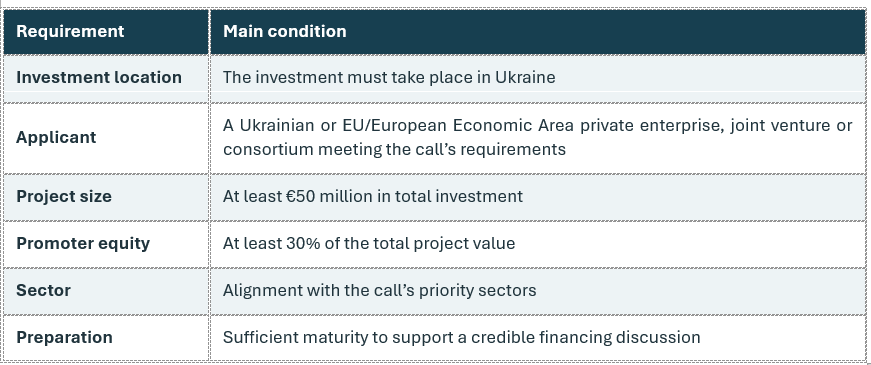
The call focuses on energy, critical raw materials, processing and manufacturing, construction materials, information technology and digital transformation, and transport and export logistics. Priority is given to mature projects with strong links to European industrial value chains, particularly EU–Ukraine industrial joint ventures and consortia.
The €50 million threshold refers to the total investment cost, rather than the amount requested from a financial institution. For a €60 million project, the 30% equity requirement would imply at least €18 million in promoter equity. The remaining financing would need to be secured through an appropriate combination of debt, additional investment or other eligible sources.
What submitting an expression of interest achieves
Companies should therefore approach the call as part of a broader financing strategy. It can facilitate access to relevant institutions, while the promoter remains responsible for demonstrating that the project is viable and deliverable.
What makes a strong proposal?
Financial capacity matters equally. Assessors consider whether the company, its shareholders or its wider corporate group can support an investment of the proposed scale. Transparent ownership, reliable financial information, sector experience and a credible equity commitment strengthen the proposal.
The commercial rationale should explain who will buy the project’s output, how revenues will be generated, what inputs are required and how the investment will compete. Its contribution to recovery and European integration should also be specific—for example, through new production capacity, more resilient energy supply, employment, technology transfer or stronger cross-border supply chains.
Applicants must use the prescribed submission templates. The current published requirements include a project fiche of no more than four pages, information on governance and ownership, and a signed declaration on honour. A concise application should reflect substantial preparation behind it.
Opportunities for Ukrainian businesses
Smaller companies have other routes. The €50 million minimum applies to this specific call, rather than to the UIF as a whole. Businesses below that threshold can explore financing delivered through participating banks and financial intermediaries.
Examples include the Ukraine SME Recovery Programme, which combines risk-sharing instruments with technical assistance, and the Financial Inclusion Recovery Programme, which supports lending through EBRD partner financial institutions. Certain programmes give particular attention to businesses affected by war damage, enterprises in conflict-affected areas, veteran-led businesses and women- and youth-led companies.
The practical starting point is to define the financing need and identify a matching programme. A company replacing machinery will require a different product from a developer financing a new energy facility. Loan size, currency, maturity, collateral, eligible expenditure and any associated investment incentives must be checked with the implementing institution.
Opportunities for European businesses
Industrial partnerships offer another route. Cooperation between European and Ukrainian companies can combine technology, capital and access to customers with local production capabilities and market knowledge. The priority given to EU–Ukraine joint ventures under the current call makes partnerships especially relevant where they create a clear commercial advantage and strengthen European supply chains.
Publicly financed recovery projects also generate demand for equipment, construction works, engineering and professional services. Businesses can pursue these opportunities through procurement conducted by Ukrainian contracting authorities and international financing institutions. Each tender has its own eligibility, technical and procedural requirements.
For European exporters, complementary instruments may also be relevant. The €300 million Ukraine Export Credit Pilot, implemented under InvestEU through participating export credit agencies, supports eligible exports by SMEs and small mid-cap companies. It is separate from the UIF and addresses a different need: facilitating trade with Ukrainian buyers.
Choosing the right route
Businesses with an early-stage concept should first address the gaps that prevent a financing decision. This may involve feasibility analysis, market assessment, financial modelling, technical design, permitting or clarification of the ownership and financing structure. The framework makes this preparation worthwhile by providing several channels through which a credible project can progress towards investment.
Why the framework deserves attention
The Ukraine Investment Framework connects recovery priorities with financing instruments designed to mobilise public and private capital. Its relevance extends across large industrial projects, smaller business investments and infrastructure programmes that create commercial opportunities throughout the supply chain.
The opportunity is strongest where a well-prepared project meets a suitable financing instrument. Businesses that can demonstrate market demand, committed equity, implementation readiness and a clear contribution to Ukraine’s recovery will be better positioned to turn that opportunity into a financing discussion.