This year, ISD Consulting joined ReBuild Ukraine in Warsaw on 12–13 November. Public authorities, businesses, international financial institutions and Ukrainian communities attended the sixth Construction & Energy exhibition and conference to discuss recovery projects, financing and opportunities for cooperation.
The event attracted more than 7,500 participants from 33 countries, over 800 companies and organisations, and representatives of more than 150 Ukrainian communities. Its principal outcomes included new business-financing agreements, additional equity commitments, energy partnerships and progress in preparing infrastructure projects.
Discussions repeatedly returned to project preparation and the conditions needed to secure financing. The agreements and proposals presented in Warsaw addressed different parts of that process, from risk-sharing for bank lending to the preparation of municipal concessions.
New financing for Ukrainian businesses
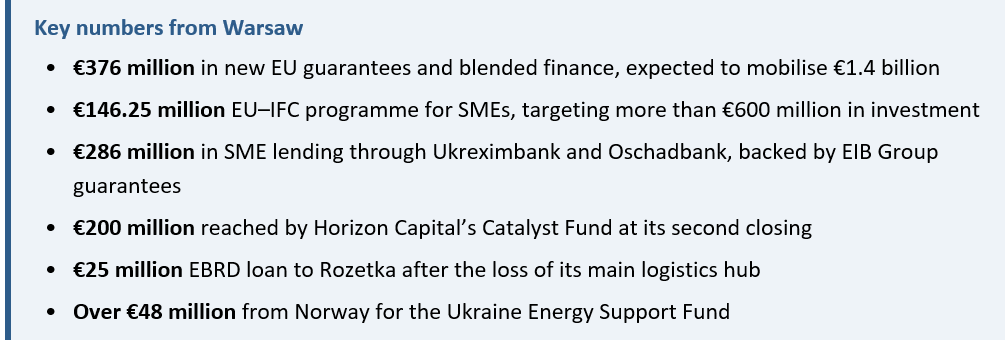
A central agreement at the EU–Ukraine Investment Conference was the European Commission–IFC programme backed by €125 million in EU guarantees and €21.25 million in grants. Expected to mobilise more than €600 million in investment, it targets businesses affected by the war, including enterprises run by or employing veterans.
The EIB Group signed guarantee agreements with Ukreximbank and Oschadbank expected to enable €286 million in financing for around 2,200 SMEs. Each bank will be able to provide up to €143 million in loans. A separate €3.4 million grant agreement with PrivatBank will complement lending under EIB Group guarantee programmes, helping make financing more affordable for eligible businesses.
PrivatBank and IFC also signed a mandate letter for a proposed risk-sharing facility covering a portfolio of up to €125 million. Under the proposed structure, IFC would assume up to half of the credit risk. The facility is intended to support enterprises including those investing in renewable energy, energy efficiency and climate-smart agriculture; its terms remain to be finalised.
Businesses will access much of this financing through Ukrainian banks. For potential borrowers, access will depend on the participating institutions’ eligibility criteria, credit assessment and implementation arrangements.
Equity investment and industrial recovery
Horizon Capital’s Catalyst Fund reached €200 million at its second closing, up from €152 million in January 2026. The EBRD committed up to €20 million in additional capital, increasing its total commitment to up to €50 million. Private investors provided approximately half of the new commitments. The fund’s first investment supports a 124 MW wind project led by Notus Energy.
The EBRD also announced €25 million in financing for Rozetka to support working capital and resilience following the destruction of its main logistics complex. The package comprises a €10 million committed tranche and a further €15 million uncommitted tranche. It supports business continuity and investments including battery storage, shelters and safety improvements, with an EU first-loss guarantee backing the Ukrainian operations.
The conference also coincided with the announcement of the U.S.–Ukraine Reconstruction Investment Fund’s (URIF) participation in UFORCE’s $700 million investment round. The figure represents the total funding round, rather than URIF’s individual contribution.
Industrial recovery discussions addressed implementation of the Industrial Ramstein mechanism with Germany’s development ministry (BMZ) and KfW. The ministry’s conference account reported €30 million allocated by Germany, preparations for a Japanese programme and discussions with further partners. The German financing builds on cooperation announced earlier in 2026. A proposed Business Support Fund was also presented, intended to expand insurance coverage and access to recovery finance from 2027.
Energy resilience and industrial cooperation
The European Commission presented four Ukraine Investment Framework programmes totalling €376 million in guarantees and blended finance, expected to mobilise €1.4 billion in investment. Approved on 4 November, ahead of ReBuild, the package covers energy, strategic industries and equity financing, including additional backing for the EU–EBRD HI-BAR programme and EU–IFC equity investment.
Private-sector cooperation included the reported €75 million Vlasne Misto agreement between a Ukrainian investor and Poland’s E-HUB in Kyiv region. The project envisages a 300 MWh energy-storage system.
Norway signed a contribution of more than €48 million to the Ukraine Energy Support Fund during the Warsaw meetings. The Energy Community Secretariat engaged manufacturers and suppliers on procurement, reporting 120 ongoing tenders worth an estimated €123.5 million and almost €349 million in tenders under preparation. These figures describe the Fund’s procurement pipeline at the time of the conference.
At Energy in Action, Ukrenergo outlined cooperation with Deloitte on risk forecasting and estimating the resources needed for infrastructure protection. The work connects assessment of physical threats with financial planning, helping determine which protective measures and equipment reserves should be prioritised.
Transport connectivity and infrastructure investment
The Ministry for Recovery, Infrastructure and Transport of Ukraine presented a portfolio of priority PPP projects in transport and municipal infrastructure. Discussions covered industrial and logistics facilities, transport corridors and opportunities for private-sector participation. The discussions covered railway reform, infrastructure investment and rolling-stock requirements.
Meetings with the European Commission’s DG MOVE addressed EU–Ukraine connectivity and the financial structuring needed to advance the European-gauge railway connection towards Lviv. The project builds on an EU grant awarded previously. Earlier work on the Uzhhorod and Kovel connections was presented as background to further integration of Ukraine’s railway network with European transport corridors.
Improved cross-border connections can support industrial investment and logistics, while delivery requires coordination among infrastructure funding, operating arrangements, sector reforms and rolling-stock availability.
Municipal projects and partnerships
Swedfund signed a memorandum to join the Ukraine Framework for Project Preparation as its fourth partner, expanding cooperation on technical and grant support for investment preparation. Separately, the EBRD and Ternopil signed an agreement to prepare a project strengthening the city’s energy resilience.
Water-sector discussions focused on PPP pilots in Dnipro, Khust and Uzhhorod. The Ministry for Recovery, Infrastructure and Transport identified safe drinking water, modern wastewater treatment and energy independence of critical infrastructure as priorities for 2027–2028, alongside the application of European standards and management practices.
Khust provided a detailed example. The expanded concession model presented at a side event with PwC covers the entire water supply and wastewater system. Estimated capital expenditure is €27 million before inflation adjustments, or approximately €34.6 million including inflation over a 20-year horizon. The proposed financing combines private investment, donor grants and municipal contributions to support affordability. Expected improvements include continuous water supply, reduced losses and greater energy efficiency.
Municipal partnerships also covered specific recovery needs. Neo Eco Ukraine signed memoranda with Shyroke and Bereznehuvate communities on debris recycling and waste management. The Lviv Agglomeration Association, Civitta Ukraine and LocationMind agreed to cooperate on technology for improved mobility.
Housing discussions addressed social and affordable rental provision and the combination of public, international and private resources. A separate ministry delegation account reported a proposed $500 million World Bank project to expand eOselia as being in the final stages of preparation.
What we took away from Warsaw
The discussions in Warsaw showed that both the public and private sectors need expert support with investment project preparation, including national infrastructure companies, private businesses, municipal utilities and local authorities. Even large organisations with experienced teams need assistance with feasibility studies, investment appraisal and the choice of financing structures.
Reflecting on the conference panels and her discussions with Ukrainian municipalities, Tetiana Tavlui, CEO of ISD Consulting, noted:
“Project preparation support is needed at every level. Smaller municipalities, however, often have fewer resources to commission studies or develop financing proposals. Despite the war and limited budgets and staff, they are developing investment projects and building international partnerships. In my view, they deserve particular attention from partners providing technical assistance, so that their priorities can be assessed and considered for financing.”